Find out which foods actually flare your bladder.
Coffee, citrus, tomatoes, anything fizzy — the standard IC lists warn you off dozens of foods at once, but your triggers aren't the next person's. Sootha tracks what you eat and how you feel, then shows the foods that keep turning up before your flares — and nudges you to try one again when your logs stay quiet.
Reserving a founding spot — the first 100, no card today. Just your email.
Free. One email when the beta opens — nothing else, and you can leave anytime.
Logging stays free forever · your first insight is free · no subscription to keep your data.
Prefer to help build it? A one-time founding spot is open — first 100, no card to reserve.
Nothing on this plate lands on the common-trigger lists — a dinner most people with IC do fine with. Your own logs get the final say.
The lists never fit you
If you have IC, you know the drill: a printout that reds-out half the menu, and a lot of trial and error to find the few things that actually set you off. Coffee wrecks some people and barely touches others. A cooked tomato isn't a fresh one. A sip isn't a mug.
And it wears on you. You start turning down dinners out, and foods you used to love — not because you know they'll hurt, but because you can't be sure they won't.
So most people end up as their own researcher — a notes app, a spreadsheet, a mental tally that never quite adds up. Sootha does that part for you.
How it works
Log in a few taps
Note what you ate and how your bladder felt. It's quick enough to keep up with on a rough day.
Check before you order
Type in a food, point your camera at a restaurant menu, or paste a recipe. You get a straight read on what to watch for, plus how sure Sootha is, like the plate above. When it isn't confident, it says so instead of guessing.
See your own patterns
After a couple of weeks of logging, Sootha connects your meals to your symptoms and shows the foods that keep showing up before a flare — and the ones that seem safe for you specifically. And when your logs stay quiet on a food you'd sworn off, it nudges you to try it again — your call, always.
See it for yourself
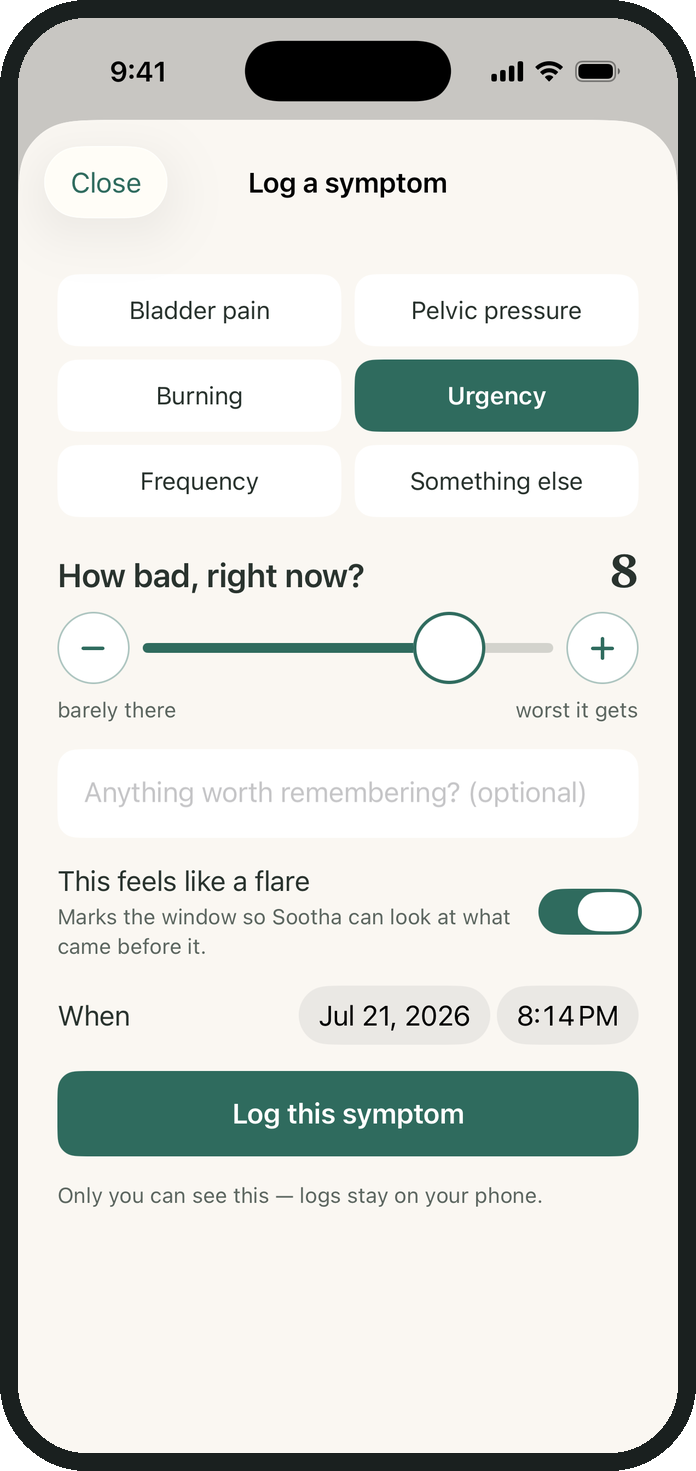
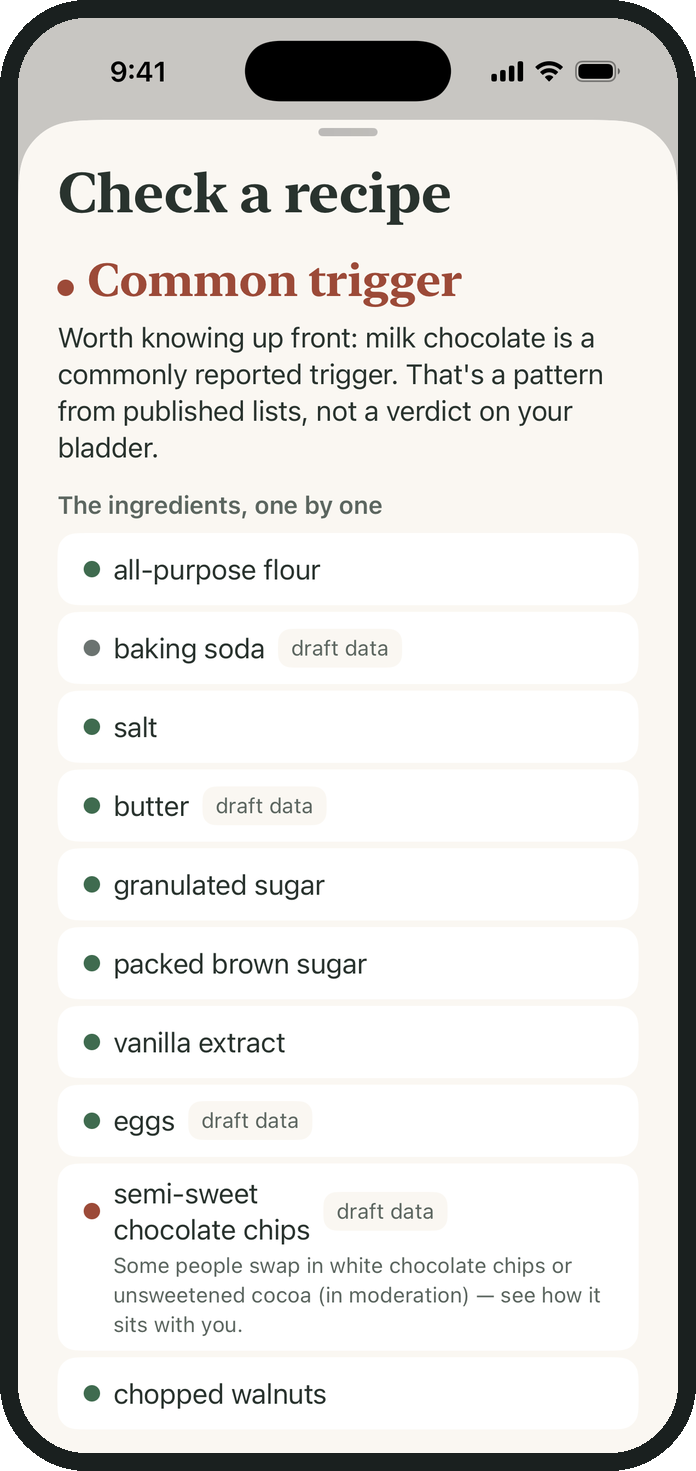
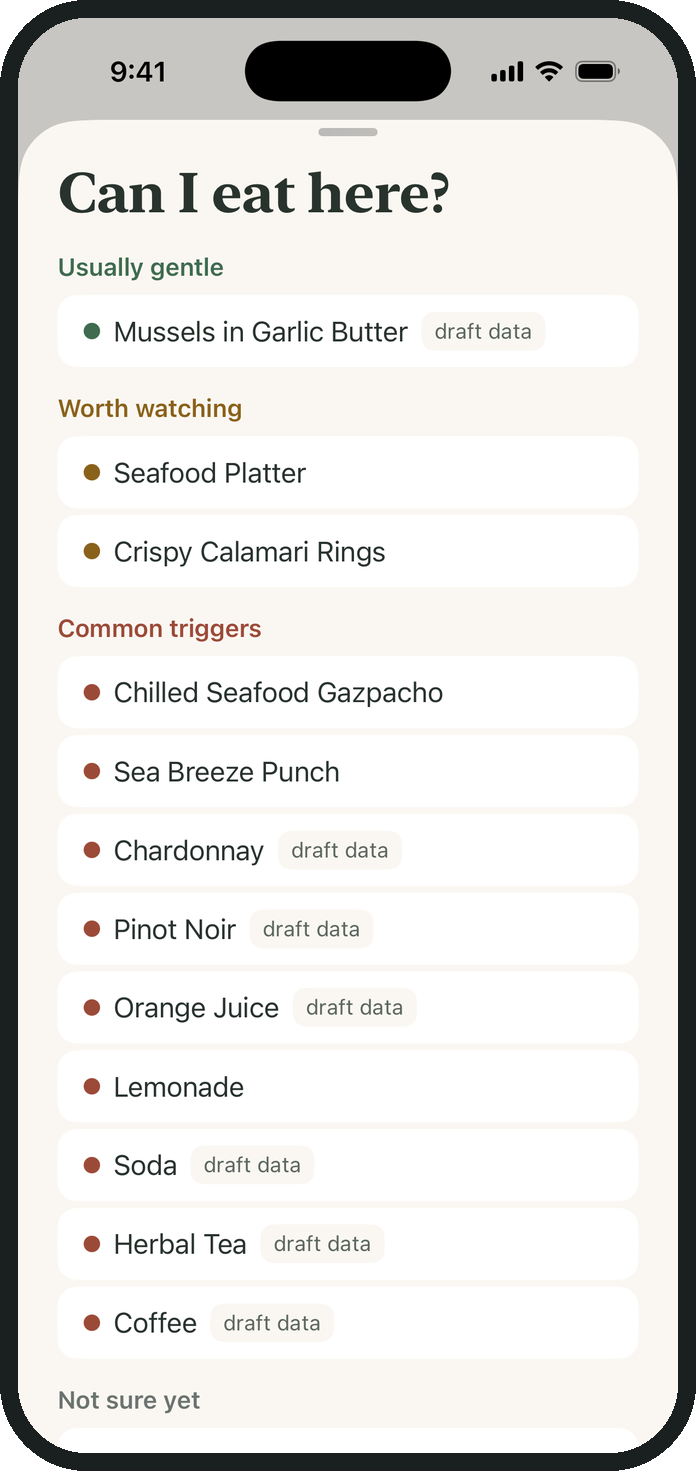
Real screens from the private build — the same calm, specific reads you'd get on your phone.
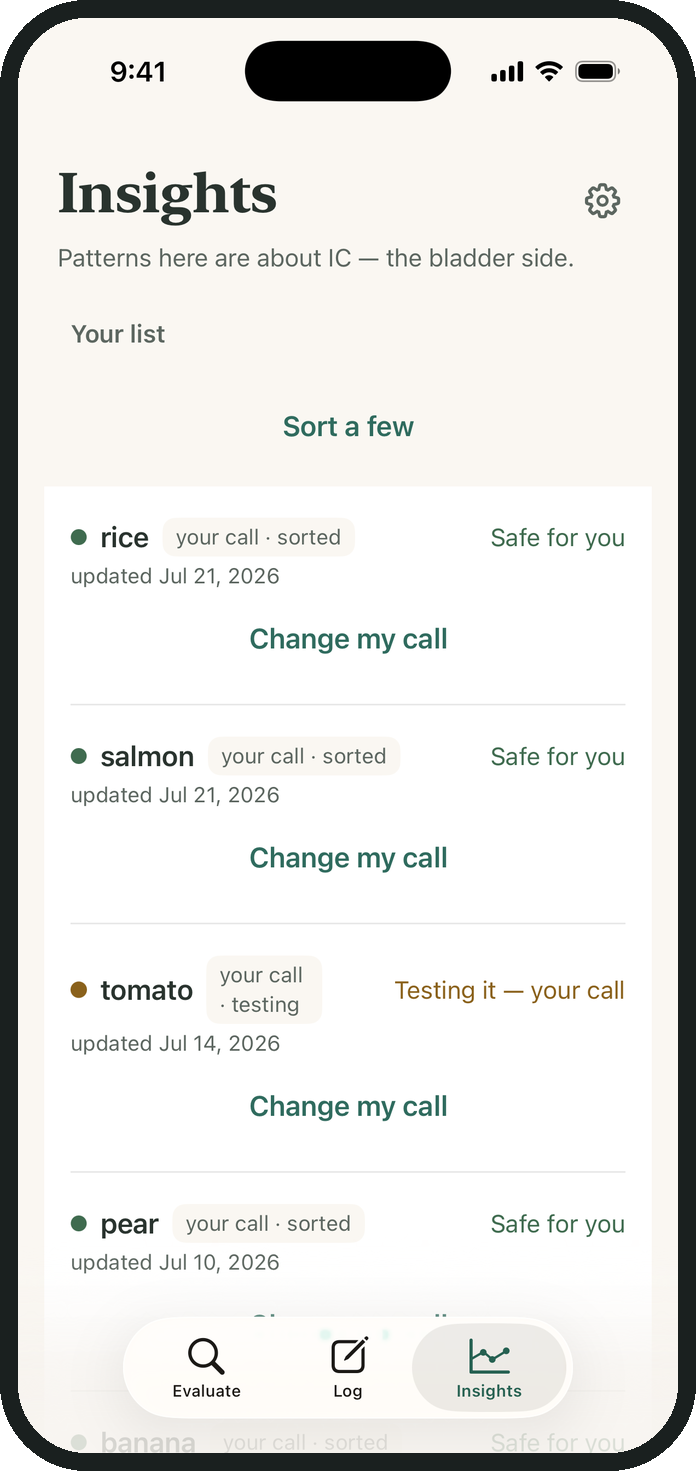
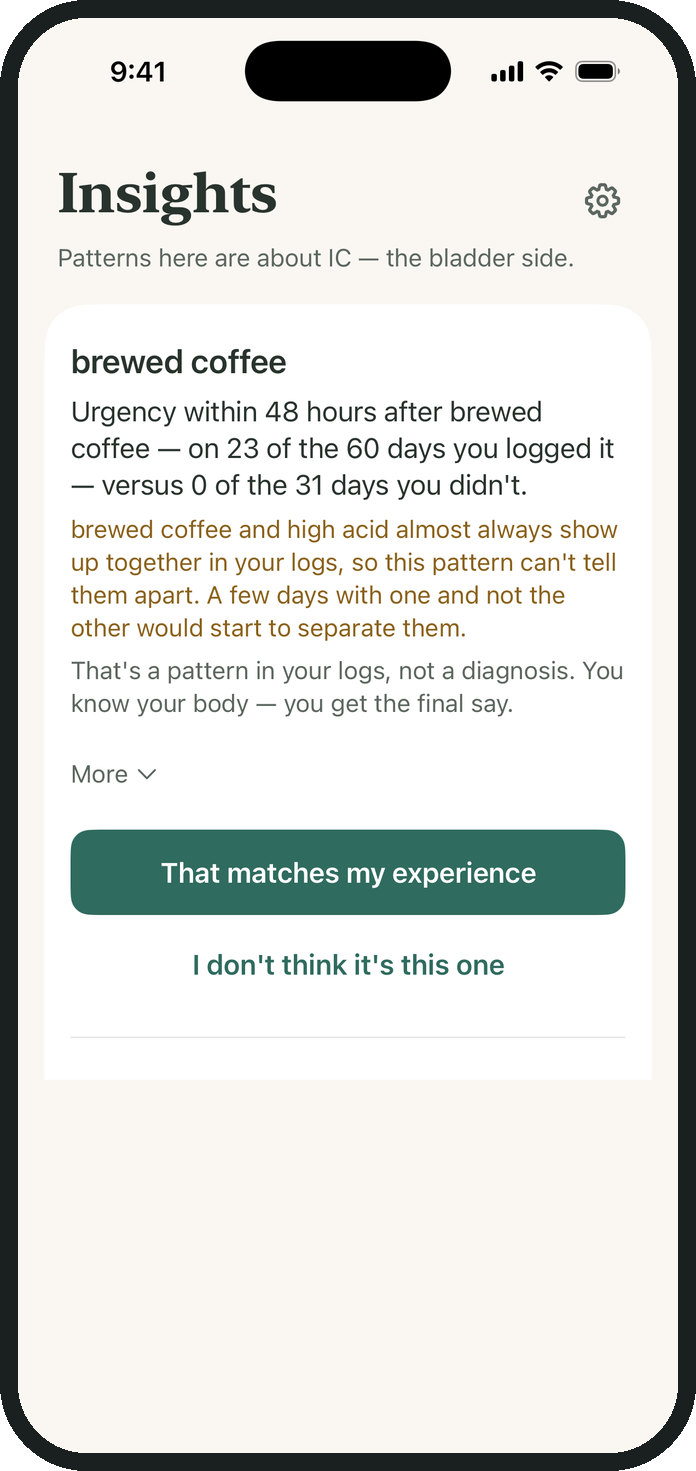
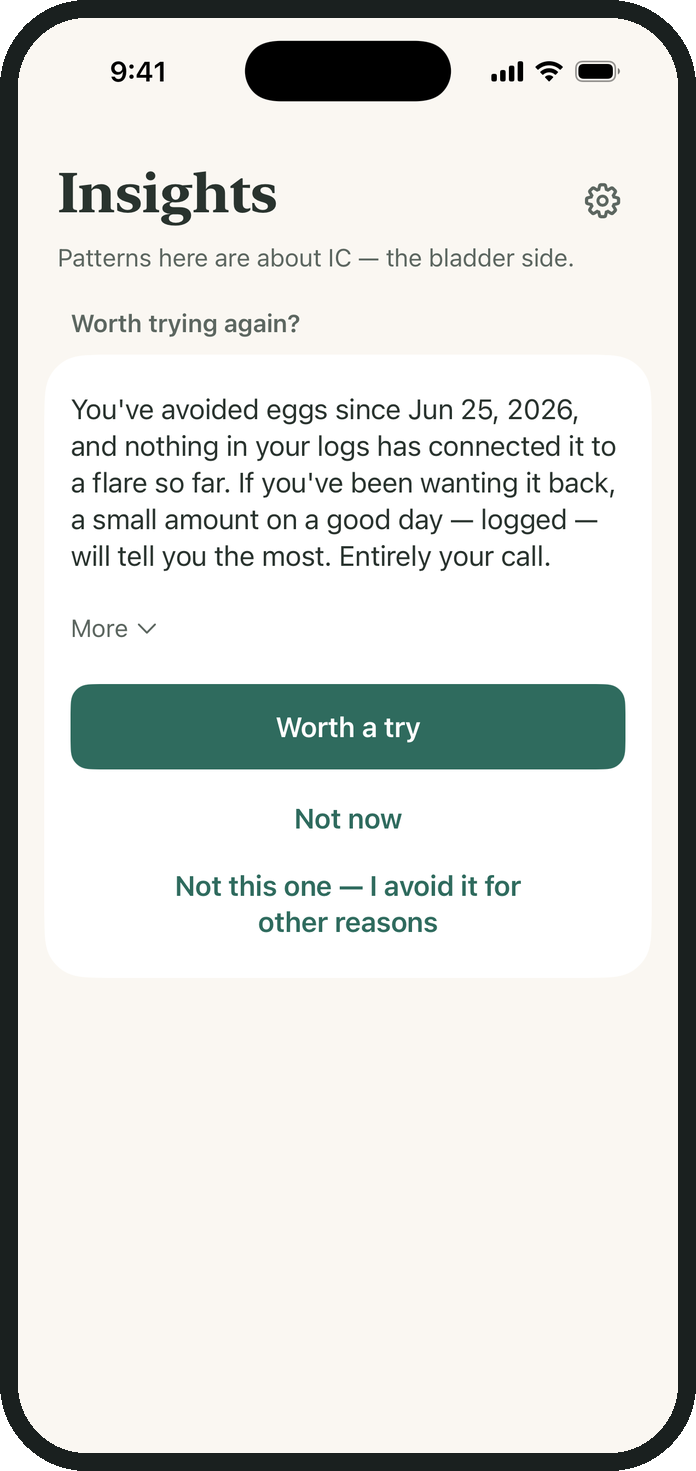
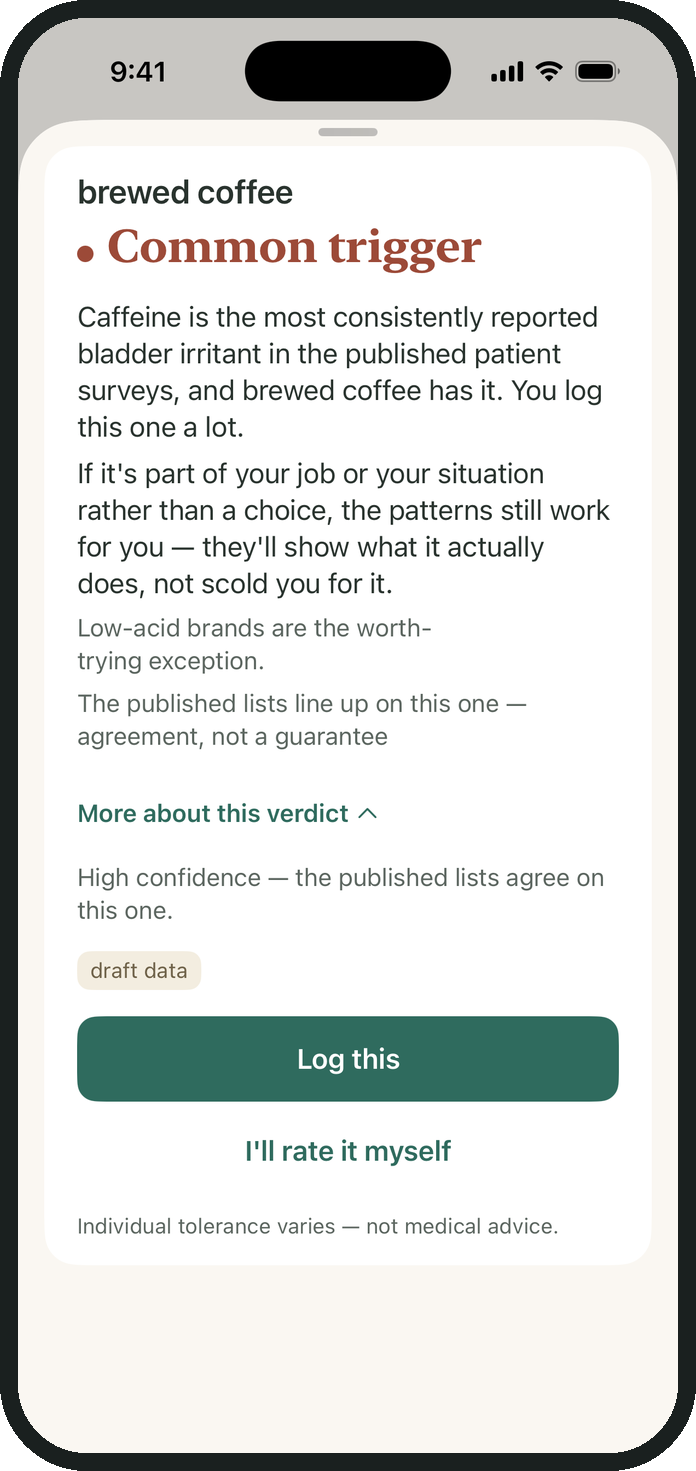
See it work
A minute and a half, unedited: checking a food, reading a menu, and what a pattern looks like after two weeks of logging.
What makes it different
A food list — or a chatbot
- Gives everyone the same read — and forgets it the moment you close the tab
- No help with a real restaurant dish or a recipe
- Treats a fresh tomato and a jar of sauce the same
- Never gets to know you
Sootha
- Learns the triggers and safe foods that are yours
- Reads real meals, menus, and recipes
- Weighs how something's cooked and how much you're having
- Gets sharper the longer you use it
Where it's going
Sootha is real software today, built by one person. Here's honestly where it stands and where it's headed — a projected plan, so it'll shift as I learn from testers. These are targets, not dates.
The real, private app you'd be testing.
- In the appCheck a food or meal
Type a food or a whole meal and get a calm read — a plain reason, how sure it is, and a line marking it as information, not medical advice. Most reads come from the curated database; only a novel food triggers a confidence-gated AI check, and that check sends just the anonymized food text through a proxy — the AI key never lives on your phone.
- In the appRead a menu from a photo
Photograph a restaurant menu and see each dish sorted by what tends to sit well with, or set off, a lot of people with IC. Low-confidence dishes get flagged, not guessed. The photo is read once and never stored.
- In the appCheck a recipe
Paste a recipe and see which ingredients tend to be common triggers, with a few informational swap ideas.
- In the appLog meals and symptoms — offline
Log a meal or a bladder symptom (0 to 10, with an optional flare mark) in seconds. It works with no signal, and your logs stay on your device.
- In the appPatterns in your own logs
After about two weeks of logging, Sootha surfaces foods that tend to show up before your flares — a pattern in your own logs with the evidence count, never a diagnosis. Your first insight is free; in the beta, it's all unlocked.
- In the appYour safe list, your call
If you disagree with a rating, your own verdict overrides the generic one everywhere in the app.
- In the appExport or delete everything
Take all your data with you, or erase it completely, whenever you want — no hoops.
The gates between the private build and the first testers — and how early supporters reserve a founding spot now.
- In progressClinical review of the safety copy
The safety wording — including the card that says when a symptom is worth a doctor's call — is in clinical review before the beta widens.
- PlannedTestFlight invites
Apple Developer enrollment just cleared, which unlocks TestFlight. The first release build waits on that clinical review; then the first runs are concierge-style — a small group, a two-week logging run.
- Open nowReserve a founding spot
Open now, through the beta: a one-time early-supporter tier, capped at the first 100 people. Reserved by email with no card, charged only when your invite goes out, self-serve refundable, and retired the moment v1.0 goes public. Logging stays free forever either way.
What it takes to open Sootha to the public — and what the App Store release adds.
- PlannedA name, an icon, the legal basics
Before a public release: settling the final name (sootha.app is available), an app icon, and getting the privacy policy and terms through legal review.
- PlannedFood-database source review
A source-review pass on the curated food database before any wide release, so every verdict traces to something real.
- PlannedQuick-add, widget, Apple Health & sync
Log from your home screen, connect with Apple Health, and optionally sync across devices — off unless you turn it on. Local-first stays the default.
- PlannedPremium goes live
Logging stays free forever, and your first insight is free. The continuous pattern engine and the menu and recipe checks become a subscription when v1.0 goes public.
Directions I'm interested in, not commitments.
- SomedayMore conditions, same engine
The engine is condition-agnostic, so new conditions are data, not rewrites — gastroparesis first, then others like histamine on request.
- SomedayA summary to share with a clinician
A clean PDF of your patterns you could hand to a doctor — still your data, framed as information.
- SomedayMaybe later
Possibly Android, barcode lookup for packaged foods, and hydration or supplement notes — no promises, just what I'm watching.
Everything past Now is shaped by the beta. As a tester, what you hit and ask for is the list I build from next.
Who's building this
Sootha is one person — me. No studio, no growth team, no investors deciding when it's done. I'm a builder who couldn't let this one go: the standard IC advice is a printed list that says no to half of everything and never gets more specific than that, and the people stuck with it deserve better than guesswork. The version that actually learns which foods are yours didn't exist — so I'm building it, slowly and in the open, with the people who live this.
Here's the honest trade of an app built this way. You don't get a support department; you get me, directly. And the beta isn't a marketing phase — it's genuinely how Sootha gets finished. The people in it are closer to co-founders than customers:
- Every beta member has a direct line to me — what you hit, what confuses you, what you wish it did. I read all of it, and I answer.
- What gets built next comes from that list, and I'll show the work: beta members see the changelog with their asks on it.
- If you want it, your name goes in the app's credits as a founding member. This gets built with you or it doesn't get built right.
And the part that doesn't depend on trusting me: your logs live on your phone. If I get hit by a bus, your history is still yours.
— Leo
Help build it, and keep it for good
Sootha is built by one person, working directly with a small group of people who deal with IC every day. Founding members get into the first beta, shape what gets built next (how that works), and keep every version of Sootha — including future condition packs — for one payment. No subscription, ever.
Why 100? Because that's how many people one person can genuinely talk with during a beta. The founding tier retires when the spots fill or the app launches publicly — whichever comes first. After that, the full engine becomes a subscription. Founding is one payment for every future version — including new condition packs — no renewals, ever.
Reserving costs nothing today — just your email. You're charged only when your beta invite goes out, refunds are self-serve for 60 days after that, and if the beta hasn't opened by March 31, 2027, every reservation dissolves automatically and nobody is charged.
One more thing, because it matters if you've been burned before: your logs live on your phone, not on a server. There is no service that can shut down and take your history with it.
Reserve a founding spotRather just wait and watch? The free waitlist up top is fine too.
Questions
Is this medical advice?
No. Sootha helps you track your food and symptoms and notice your own patterns. It doesn't diagnose or treat anything, and it isn't a substitute for your doctor or dietitian. Anything that looks serious, take to them.
How is it different from a food list I can find for free?
A list gives everyone the same answer. Sootha works out which foods affect you from your own logs, and it can weigh in on a real dish or recipe — including how it's prepared and how big the portion is.
Can't I just ask a chatbot?
You can, and for a general read it'll do fine — the same general read it gives everyone, forgotten the moment you close the tab. Sootha's answer is different because it's built on your own logged weeks: it knows coffee cleared you but champagne didn't, it tells you how sure it is instead of sounding confident either way, and your history stays on your phone rather than in a chat log.
Is it iPhone only?
Yes, to start — Sootha is a native iPhone app, built for iOS first so it can be genuinely good there. Whether Android follows depends on how the beta goes; the waitlist hears first either way.
Will it cover conditions other than IC?
I'm starting with IC and getting it right before I look at anything else.
What happens to my data?
Your meals and symptoms live on your phone — there's no account and no server holding your history. When you ask for an AI read on a novel food, only the food words you asked about are sent, never your logs. You can export or delete everything whenever you want.
When does it open?
I'm checking with the IC community first, then opening a small beta. Waitlist and founding members get in first.